The Meaning of Medicare’s 2027 Costs for Your Social Security Check
In Every fall, two announcements determin how much money lands in your bank account the following January: the Social Security cost-of-living adjustment (COLA) and the Medicare Part B premium. For most people, the premium comes straight out of the Social Security check, so the raise you are promised and the raise you actually see are not the same number. This guide walks through the official 2027 figures, shows what they mean for different types of retirees with worked examples, and explains what to check before January.
Points to note
- Social Security benefits will rise 3.6% in January 2027, which adds about $75 a month for the average retired worker.
- The standard Medicare Part B premium will rise 3.2%, or $6.50, to $209.40 a month. The Part B deductible rises to $292.
- This is the first time since 2023 that the premium increase is smaller than the COLA, so most people will see their net check go up.
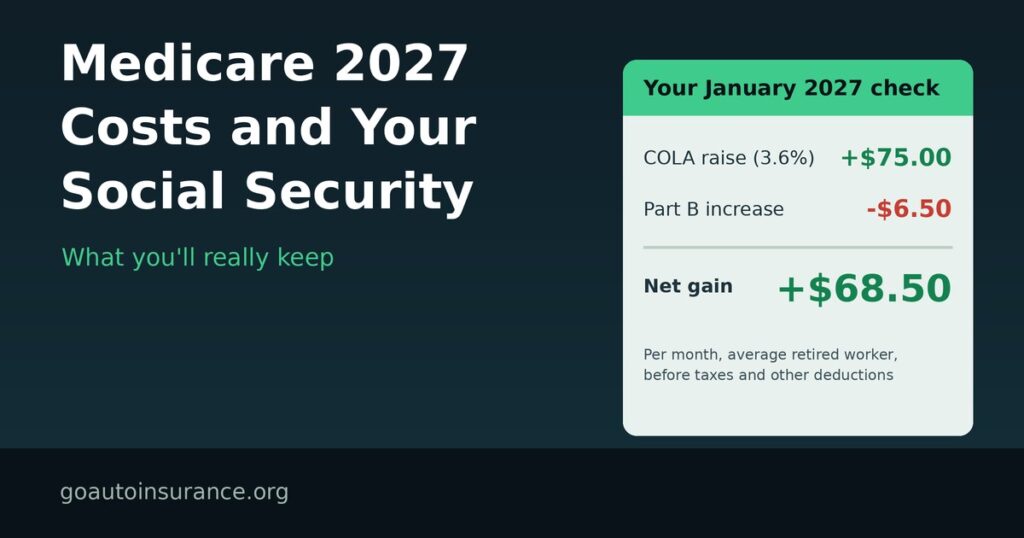
- The raise still shrinks: for an average retiree, about $75 more in benefits becomes about $68.50 more after the Part B increase.
- Higher-income retirees pay extra surcharges (called IRMAA) that can add $83.70 to $502.40 a month to Part B, plus extra for Part D.
The two numbers that matter
Social Security: a 3.6% raise
The Social Security Administration (SSA) announced on October 14, 2026 that benefits will rise 3.6% beginning in January 2027. SSA says retirement benefits will increase by about $75 a month on average. Nearly 72 million Social Security beneficiaries are covered by the adjustment, and SSA’s estimates put the average retired worker’s monthly benefit moving from roughly $2,095 to about $2,170. These are averages based on current benefits, so your own increase depends on your own benefit amount. SSA said personalized COLA notices would be available online starting in late November 2026.
Medicare Part B: a 3.2% increase
The Centers for Medicare & Medicaid Services (CMS) announced on November 17, 2026 that the standard Part B premium will be $209.40 a month in 2027, up $6.50 from $202.90 in 2026. That works out to about $2,512.80 a year. The annual Part B deductible rises by $9, from $283 to $292. CMS said the increase is mainly due to projected growth in health care spending.
Because the 3.2% premium increase is smaller than the 3.6% COLA, 2027 is the first year since 2023 that the Part B increase trails the COLA, as reported by the 401(k) Specialist magazine. By comparison, in 2023 the premium actually fell 3.1% while the COLA was 8.7%.
Medicare’s 2027 costs at a glance
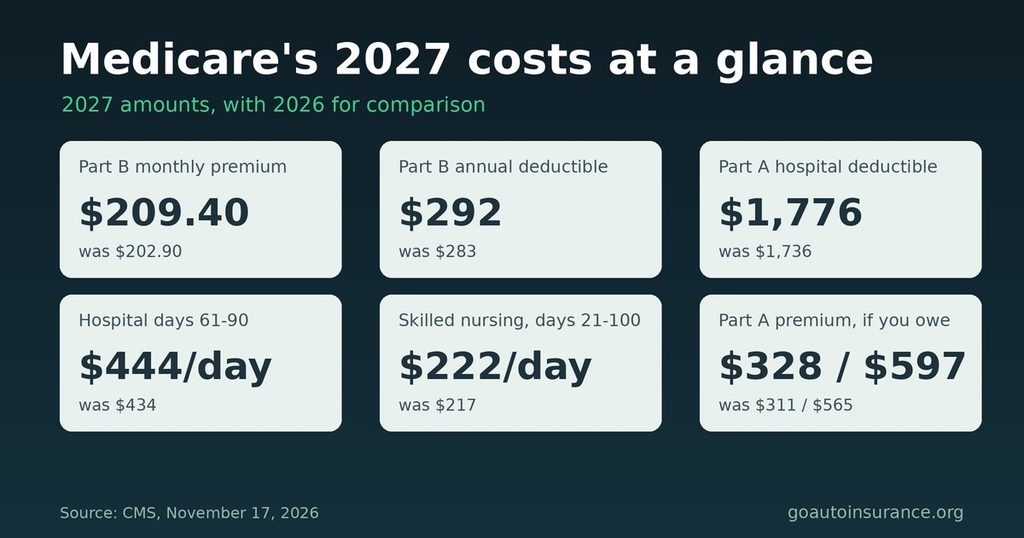
Here are the official CMS figures for 2027 compared with 2026.
Part B (medical insurance: doctors and outpatient care)
- Standard monthly premium: $209.40 (was $202.90)
- Annual deductible: $292 (was $283)
- Premium for kidney-transplant immunosuppressive drug coverage only: $125.70
Part A (hospital insurance)
- Inpatient hospital deductible per benefit period: $1,776 (was $1,736)
- Daily coinsurance for hospital days 61 to 90: $444 (was $434)
- Daily coinsurance for lifetime reserve days: $888 (was $868)
- Daily skilled nursing facility coinsurance, days 21 to 100: $222 (was $217)
- Part A premium: about 99% of beneficiaries pay nothing because they have at least 40 quarters of Medicare-covered work. People with 30 to 39 quarters pay $328 a month (was $311), and those with fewer pay up to $597 a month (was $565).
What it means for your Social Security check
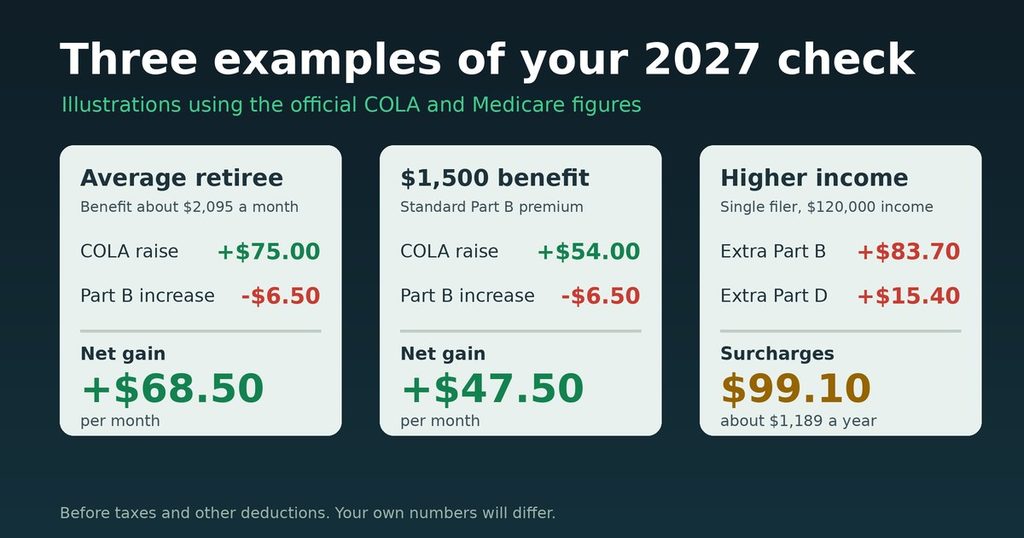
The examples below are illustrations based on the official COLA and premium figures. They show benefit amounts before taxes and other deductions, and your own numbers will differ.
Example 1: The average retired worker
- Benefit before COLA: about $2,095. After the 3.6% COLA: about $2,170, an increase of about $75.
- Part B premium: rises $6.50.
- Net increase: about $68.50 a month, or about $822 a year.
In other words, roughly 8.7% of the raise is absorbed by the higher Part B premium.
Example 2: A lower benefit
Suppose someone receives $1,500 a month and pays the standard Part B premium.
- 2026: $1,500 minus $202.90 = $1,297.10
- 2027: $1,554 (after a 3.6% COLA) minus $209.40 = $1,344.60
- Net increase: $47.50 a month.
Part B takes about 13.5% of the benefit in both years. For lower-income retirees, the premium is a large share of the check, which is why the increase matters even when it is smaller than the COLA.
Example 3: A higher-income retiree
Part B premiums are higher for people with higher income. Suppose a single filer’s income (modified adjusted gross income) is $120,000, which is in the second bracket. For 2027 that person pays $293.10 a month for Part B, which is $83.70 more than the standard premium, and an extra $15.40 a month for Part D drug coverage under the income-related rules. That is $99.10 a month in surcharges, or about $1,189 a year, on top of the regular premiums.
Check out the High-income surcharges (IRMAA) for 2027
Income-related monthly adjustment amounts, or IRMAA, add to your Part B and Part D premiums if your income is above certain levels. CMS says they affect roughly 9% of people with Part B. Medicare generally looks at your tax return from two years earlier, so your 2027 premium is based on your 2025 income.
Part B total monthly premium, single filers (income on individual returns):
- $112,000 or less: $209.40
- Above $112,000 up to $141,000: $293.10
- Above $141,000 up to $177,000: $418.80
- Above $177,000 up to $212,000: $544.40
- Above $212,000 and below $500,000: $670.00
- $500,000 or more: $711.80
For married couples filing jointly, the income thresholds are double (for example, $224,000, $282,000, $354,000, $424,000 and $750,000). Married people who file separately and lived with their spouse during the year face different rules, so check the CMS table.
Part D extra monthly amounts (added to your plan’s premium): $15.40, $39.70, $64.00, $88.30 and $96.40 across the same income brackets, from lowest to highest above the base level.
If your income has dropped
Because the surcharge is based on older tax data, it can be too high if your life has changed. The Social Security Administration allows people to ask for a new decision after a life-changing event, such as retiring or reducing work, marriage, divorce, or the death of a spouse. Contact SSA to ask how to request this.
What about a hospital stay?
Hospital costs are covered under Part A, which has deductibles and coinsurance. Here is an illustration. Suppose someone has a 65-day hospital stay in 2027:
- Inpatient deductible: $1,776
- Days 61 to 65 are five days of coinsurance at $444, or $2,220
- Total Part A cost: $3,996, not counting doctor charges under Part B
Many people have extra coverage, such as a Medigap policy or Medicare Advantage plan, that changes these costs, so check what yours pays.
What to do before January
1. Check your COLA notice
SSA said personalized COLA notices would be available online beginning in late November. Look for your new benefit, the Part B premium being withheld and any other deductions. If you have not set up an online account, you can create one at ssa.gov.
2. Update your budget
Base your plan on the net amount, not the headline COLA. Use the examples above to estimate.
3. Review your plan during open enrollment
Medicare open enrollment runs until December 7. Compare Medicare Advantage and Part D plans for 2027, including premiums, deductibles, drug lists and networks. The Part B premium is the same regardless of which plan you pick, in most cases, but your other costs can differ widely. AARP reports that the annual cap on out-of-pocket drug costs in Part D rises to $2,400 in 2027, so check what your plan covers.
4. See if you qualify for help paying premiums
State Medicare Savings Programs can help people with limited income pay the Part B premium and sometimes other costs. Ask your state Medicaid agency or your State Health Insurance Assistance Program (SHIP), which offers free counseling, whether you qualify.
5. If you are subject to IRMAA, check the details
Read your premium notice carefully. If your income has fallen, ask about a new decision. A tax professional can also help you understand how the surcharge may affect your decisions about withdrawals and other income.
6. If you are new to Medicare, check how you will be billed
People who are newly enrolled or who do not receive Social Security benefits may be billed directly for the premium instead of having it deducted automatically. Ask Medicare how and when you will pay so you don’t miss a bill.
Common mistakes to avoid
- Assuming the COLA is all extra money. Part B and other deductions come out of it.
- Ignoring IRMAA letters. An outdated income figure could cost you hundreds of dollars a year.
- Skipping open enrollment. Part D and Medicare Advantage costs change every year.
- Missing help programs. People with limited income may qualify for help with premiums.
- Using last year’s numbers. Deductibles and coinsurance have changed.
Frequently asked questions
Will my Social Security check go down in 2027? For most people, no. The COLA of 3.6% is larger than the 3.2% rise in the Part B premium, so most people will see a higher net check. Other deductions, such as taxes or higher Part D premiums, can change the amount.
Do I pay the Part B premium if I’m on Medicare Advantage? Yes, in most cases. Medicare Advantage members generally still pay the Part B premium, in addition to any plan premium.
How do I find out my exact Part B premium? Your premium notice and your Social Security statement show the amount. The standard premium is $209.40, but it may be higher if you are subject to IRMAA.
When will I see my new benefit amount? SSA said online notices would be available beginning in late November, and the new payments begin in January.
Is Part A free? For about 99% of beneficiaries, yes, because they have enough work history. Others pay a monthly premium.
Sources and further reading
- CMS, 2027 Medicare Parts A & B Premiums and Deductibles (November 17, 2026): https://www.cms.gov/newsroom/fact-sheets/2027-medicare-parts-b-premiums-deductibles
- Social Security Administration, Social Security Announces 3.6 Percent Benefit Increase for 2027 (October 14, 2026): https://www.ssa.gov/news/en/press/releases/2026-10-14.html
- 401(k) Specialist, 2027 Medicare Part B premium increase smaller than Social Security COLA: https://401kspecialistmag.com/2027-medicare-part-b-premium-increase-smaller-than-social-security-cola/
- Money, Medicare Part B adjustment for 2027: https://money.com/medicare-part-b-adjustment-2027-social-security/
- Newsweek, How Medicare hike will eat into Social Security raise in 2027: https://www.newsweek.com/how-medicare-hike-will-eat-into-social-security-raise-in-2027-12738665
- Newsweek, Social Security COLA revealed: what the 3.6% increase means for retirees: https://www.newsweek.com/social-security-cola-revealed-what-3-6-increase-means-for-retirees-12565292
- MOAA, What you’ll pay for Medicare Part B in 2027: https://www.moaa.org/content/publications-and-media/news-articles/2026-news-articles/benefits/what-youll-pay-for-medicare-part-b-in-2027/
- Finger Lakes 1, Medicare Part B premium will rise to $209.40 a month in 2027: https://www.fingerlakes1.com/2026/11/19/medicare-part-b-premium-will-rise-to-209-40-a-month-in-2027/
- Becker’s Payer Issues, Medicare Part B premium growth cools for 2027: https://www.beckerspayer.com/?p=30681
- AARP, Medicare Part B premium expected to rise in 2027 and COLA estimate: https://www.aarp.org/medicare/medicare-part-b-premium-2027/
- Your State Health Insurance Assistance Program (SHIP), Medicare.gov and SSA.gov.
Premiums, deductibles and income limits are official CMS figures for 2027, but examples in this article use averages and hypothetical situations. Your own costs depend on your benefit amount, income, coverage and state. Check your SSA and Medicare notices for your exact figures.
This article is general information, not insurance, legal or financial advice. Policies, prices and rules vary by insurer and location, so confirm details with your insurer or a licensed agent. See our editorial policy.