Medicaid Work Requirements Start January 1, 2027: What You Need to Know
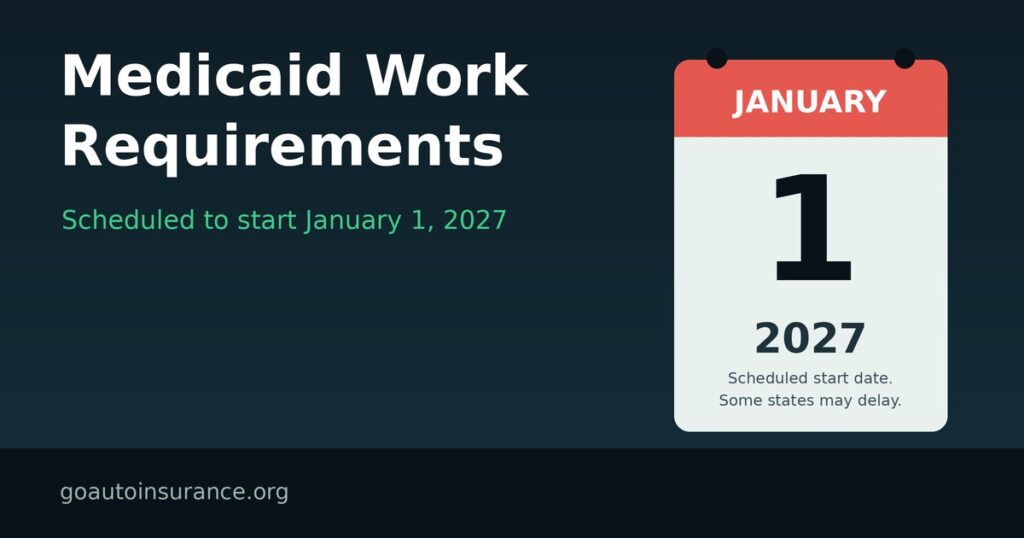
Starting January 1, 2027, many adults who get Medicaid through their state’s Affordable Care Act (ACA) expansion will have to show that they are working, volunteering or in school. It is the biggest change to Medicaid eligibility in years, and the rules have been changing even in the last few weeks, through a court ruling, state lawsuits and a new federal option for states to delay enforcement. This guide explains who is affected, what counts, who is exempt, how states will check, and what you can do now to protect your coverage.
Points to note
- A 2025 federal law requires most states to make certain Medicaid expansion adults aged 19 to 64 show 80 hours a month of work, community service, a work program or school, unless they qualify for an exemption.
- States must check at application and at least every six months at renewal. The first “look-back” month in states starting on schedule is December 2026.
- The requirement is scheduled for January 1, 2027, but on November 13 the federal government told states they may choose to suspend enforcement until June 30, 2027. Check what your state decided.
- A federal court on October 29 partly struck down part of the federal rule on who counts as medically frail. The administration said it will appeal, so details may change.
- The most important step is to find out whether it applies to you, keep your contact information current, and respond to every notice on time.
Who is affected?
The requirement applies to adults aged 19 to 64 in the ACA Medicaid expansion group, and to some states’ waiver programs that cover a similar population. It does not apply to everyone on Medicaid. Children, older adults, and people who qualify through other pathways are generally not in this group, and Medicare is separate.
One law firm counts 44 jurisdictions (43 states plus the District of Columbia) that must implement the requirement on January 1, 2027, covering roughly 30% of the Medicaid population. It does not apply in Wyoming, Texas, Kansas, Mississippi, Alabama, Florida and South Carolina. Other reports count the states slightly differently, so check with your state Medicaid agency.
Important things to note as the requirement
Adults need to complete at least 80 hours a month of one or more qualifying activities:
- Employment. Or income equal to 80 hours at the minimum wage, according to the Center on Budget and Policy Priorities.
- A work program, such as job training.
- Community service or volunteering.
- School. Enrollment at least half-time. KFF Health News reports that, under the rules, students need to be enrolled in six credit hours per semester to count as half-time, and that an unpaid internship can count toward the 80 hours.
You can combine activities to reach 80 hours.
An Illustration
This is a hypothetical illustration. Suppose someone works 18 hours a week. In a five-week month, that is 90 hours, so they meet the requirement. In a four-week month, it is 72 hours, which falls short. Because the requirement is measured by month, not by weekly average, adding eight hours of volunteering in the short month could close the gap. This is why keeping records every month matters.
Who is excluded?
The law lists mandatory exemptions. KFF describes them as including:
- Parents and caretakers of children age 13 and under
- People who are medically frail
- People who are pregnant or postpartum
Other reports list disabled veterans and people who are incarcerated, among others. The full list is in the federal law and your state’s rules, so check it carefully.
The “medically frail” question
This is the most contested part. In June 2026, CMS issued an interim final rule that took a narrower view of medical frailty than states had been told to expect. Georgetown’s Center for Children and Families and the Center on Budget and Policy Priorities, which oppose the requirement, argue this will mean fewer people are exempted and more paperwork is required. CMS has said its goal is to protect vulnerable people while encouraging employment.
On October 29, a federal court partly vacated the conflicting part of the rule and blocked its enforcement, and the administration has said it will appeal. States must update the notices they send to enrollees to reflect the ruling. Because this is changing, ask your state exactly how it is handling medical frailty now.
How will states check?
- At application: the state must “look back” at one to three consecutive months before the application month to confirm compliance.
- At renewal: states must re-verify at least every six months, and can check more often. They look back at one or more months.
- Using data: states are expected to use available data sources, such as unemployment and wage records, to confirm work or exemption status without asking enrollees for paperwork where possible.
- State choices: states can be stricter than the federal minimum, for example by checking more often or using longer look-back periods.
For states starting on January 1, the first look-back month is December 2026, so you may already need to be keeping records.
What’s changed in the last few weeks
- June 1: CMS published its interim final rule on how the requirement works.
- October 29: a federal court partly vacated the rule’s narrow definition of medical frailty.
- November 5: four states (Oregon, Minnesota, New Mexico and Washington) sued, asking the court to delay implementation.
- November 13: CMS told states they can choose a “hold harmless” period suspending enforcement until June 30, 2027.
- Already underway: Nebraska began enforcing the requirement on May 1 and Montana has also started. Nebraska’s state data showed it had denied 557 new applicants because of the requirement by August, and the state says it will not use the delay period. Georgia has had a similar program since 2023, under a waiver that expires December 31, 2026.
The midterm elections gave Democrats control of Congress starting January 3, but analysts say undoing the law’s Medicaid changes will be difficult, so the January 1 date is still the planning assumption. Law firm analysis notes that the future of the requirement is unclear.
[Optional but recommended: add a short paragraph from your own experience, such as how you or someone you know has dealt with Medicaid paperwork, in your own words. Only include things that are true.]
What supporters and critics say
Supporters say the requirement encourages work and community involvement and that it focuses Medicaid on people who most need it. Federal officials say strong exemptions are meant to protect people who cannot reasonably be expected to work.
Critics say most expansion adults already work or have good reasons not to, and that the main effect will be coverage loss from paperwork problems. They point to earlier state experiments, noting that in Arkansas existing enrollees lost coverage for failing to meet requirements. Projections made before the October ruling estimated about 5.3 million people could lose Medicaid coverage by 2034 because of the requirements.
These are projections, and the actual effects will depend on state implementation.
What you have to do now
1. Find out whether it applies to you
Check your state Medicaid agency’s website or call the number on your Medicaid card. Ask: Am I in the expansion group? When does my state start? Did my state choose the delay?
2. Keep your contact information current
New rules also add address reporting. Make sure the state has your current mailing address, phone number, email and any online account login. Missing a notice is one of the main ways people lose coverage.
3. Read every notice and respond on time
Open mail and online messages from Medicaid. Note deadlines and what is being asked.
4. Check for an exemption
If you might be exempt, such as a parent of a child 13 or under, someone who is medically frail, pregnant or postpartum, ask how to claim it and what proof is needed.
5. Start keeping records now
Useful documents include:
- Pay stubs, timesheets or a letter from your employer
- Proof of school enrollment and credit hours
- A letter from a volunteer organization showing your hours
- Records of a work or job training program
- Medical documentation if you may qualify as medically frail
6. Report your hours if your state requires it
Some states will check data automatically, while others will ask you to report monthly. Find out which applies and how to submit.
7. Ask for help early
Free help may be available through community health centers, hospital financial counselors, legal aid organizations, navigators and your state Medicaid agency.
8. If your coverage is denied or ended, appeal fast
The notice should explain how to appeal and the deadline. Appeal quickly, and ask whether you can keep your coverage while the appeal is pending. Also ask about other coverage options, since rules for other programs, including marketplace subsidies, may be affected, so get advice before assuming anything.
Common mistakes to avoid
- Assuming it does not apply to you. Check your category.
- Ignoring mail. Notices have deadlines.
- Not keeping records. You may need to prove hours for particular months.
- Assuming the delay means no rules. Some states may still ask for reporting, and the delay can differ by state.
- Waiting until you lose coverage to ask for help.
- Counting on a weekly average. The requirement is measured monthly.
Frequently asked questions
Does this apply to children or older adults?
No. It applies to adults aged 19 to 64 in the expansion group, with exemptions.
Can my state delay it?
The law allows states to request a good-faith delay through December 31, 2028, and on November 13 CMS offered a hold-harmless option until June 30, 2027. Whether your state used it is a state decision, so check.
What if I’m sick or can’t work?
You may qualify for the medically frail exemption or another exemption. Ask your state what proof it needs, because the definition is being contested.
Does it affect Medicare or CHIP?
Not directly. It applies to certain adults in the Medicaid expansion group.
Where can I follow the latest changes?
Your state Medicaid agency, Medicaid.gov, and KFF’s Medicaid work requirements
Sources and further reading
- KFF, A closer look at the work requirement provisions in the 2025 federal budget reconciliation law: https://www.kff.org/medicaid/issue-brief/a-closer-look-at-the-work-requirement-provisions-in-the-2025-federal-budget-reconciliation-law/
- KFF, Tracking implementation of the Medicaid work requirements: https://www.kff.org/medicaid/medicaid-work-requirements-tracker-1115-waivers/
- KFF, The medical frailty exemption: key takeaways from the CMS interim final rule: https://www.kff.org/medicaid/the-medical-frailty-exemption-from-medicaid-work-requirements-key-takeaways-from-the-cms-interim-final-rule/
- KFF Health News, Medicaid work requirements final rules and exemptions: https://kffhealthnews.org/public-health/medicaid-work-requirements-final-rules-exemptions-trump-cms/
- Georgetown CCF, Explainer of the interim final rule: https://ccf.georgetown.edu/2026/07/16/new-federal-medicaid-work-reporting-requirements-rule-threatens-coverage-for-vulnerable-americans-an-explainer-of-the-interim-final-rule/
- Center on Budget and Policy Priorities, Administration’s last-minute restrictions: https://www.cbpp.org/research/health/administrations-last-minute-restrictions-likely-to-worsen-impact-of-medicaid-work
- Morgan Lewis, Medicaid work requirements remain on track despite partial vacatur (November 6, 2026): https://www.morganlewis.com/ru/pubs/2026/11/medicaid-work-requirements-remain-on-track-despite-partial-vacatur
- Healthcare Dive, 4 states sue HHS to stop Medicaid work requirements: https://www.healthcaredive.com/news/4-states-sue-hhs-to-stop-medicaid-work-requirements/874191/
- The Philadelphia Inquirer, Administration will let states delay enforcement: https://www.inquirer.com/news/nation-world/medicaid-work-requirement-enforcement-delay-july-trump-jeffries-20261114.html
- States Newsroom, States struggle to impose new Medicaid work rules, even with 6-month reprieve: https://www.newsfromthestates.com/node/438879
- States Newsroom, Nebraska doubles down on adopting Medicaid changes early: https://www.newsfromthestates.com/node/438996
- Ballotpedia, Nebraska becomes first state to implement Medicaid work requirements: https://news.ballotpedia.org/2026/05/05/nebraska-becomes-first-state-to-implement-medicaid-work-requirements-after-passage-of-the-one-big-beautiful-bill-act/
- Health Care Finance News, Medicaid enrollment falls 7.4% across five major insurers: https://www.healthcarefinancenews.com/news/medicaid-enrollment-falls-74-across-five-major-insurers
- Your state Medicaid agency and Medicaid.gov.
This topic is changing quickly, with court cases, state decisions and federal guidance still developing. Some sources are advocacy organizations, law firms or news outlets with differing views, and projections are estimates. Check your state Medicaid agency for current rules before acting.
This article is general information, not insurance, legal or financial advice. Policies, prices and rules vary by insurer and location, so confirm details with your insurer or a licensed agent. See our editorial policy.