Employer Health Plans: The Cost, and Your Paycheck
Do you know Employers are feeling the squeeze too. If you get health insurance through your job, you have probably noticed that more of each pay check goes toward it every year. Several major surveys now project the biggest jump in employer health costs in two decades. This guide explains what is pushing those costs up, how employers are responding, and what you can do during open enrollment to protect your budget.
Points to note
- Employers expect their health benefit costs to rise roughly 8% to 11% per employee in 2027, depending on the survey, before they make changes to control spending.
- Workers are already paying more: the average worker contribution for family coverage rose 9% in 2026, to $7,471.
- The main drivers are expensive drugs (including GLP-1 weight-loss medications, specialty drugs and gene therapies), costly cancer and other high-cost claims, higher use of care, and rising hospital prices.
- Many employers will respond by raising what employees pay, through higher premiums, bigger deductibles or tighter plan designs.
- You can’t change your employer’s costs, but you can choose your plan carefully and use the tools it offers.
Employers Expectations
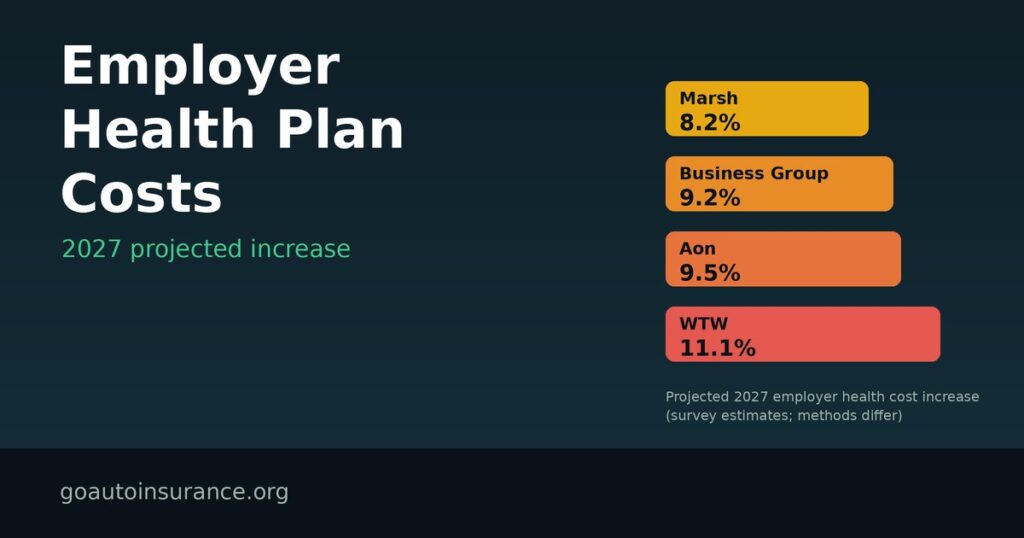
Different consulting firms and employer groups publish their own projections, and they use different methods. They land in a similar range:
- Marsh (Mercer): 8.2% per employee, the largest increase since 2003. Mercer’s figures show the rate of increase itself has gone up for four years in a row: 4.5% in 2024, 6% in 2025, 6.7% in 2026 and a projected 8.2% in 2027.
- Business Group on Health: a median of 9.2%, or about 8% after employers make plan design changes.
- Aon: 9.5%, pushing average spending above $19,000 per employee. Aon says its figure is before cost-control steps, so actual costs could be lower.
- WTW: 11.1% before plan changes, or 9.7% after, which it called the highest increase in more than two decades. WTW noted that a nearly 10% rise is almost three times the pace of wage growth.
- International Foundation of Employee Benefit Plans: a median of 10%.
These are projections, not final numbers. The Business Group on Health pointed out that actual costs exceeded employers’ projections for three years in a row, and the gap grew each year from 2023 to 2025.
What workers are paying now
The most reliable look at what has already happened comes from KFF’s 2026 Employer Health Benefits Survey, published October 22, 2026.
- Average annual premiums for family coverage reached $28,303, up 5% from 2025. Single coverage averaged $9,804, also up 5%.
- Workers paid an average of $7,471 toward family coverage, up 9% (or $621). For single coverage, the average worker contribution was $1,672.
- The average deductible for single coverage among workers with a general deductible was $1,955.
- Small firms are harder on workers. Employees at smaller firms paid an average of $9,687 toward family coverage, compared with $6,840 at firms with 200 or more workers. The average family contribution rate was 37% of the premium at smaller firms and 25% at larger ones.
- Thirteen percent of covered workers, including 31% of those at smaller firms, are in a plan where they contribute $12,000 or more for family coverage.
In the small-group market, health insurers are seeking a median premium increase of 14% for 2027, according to a Healthcare Finance News report.
The main cost drivers
There is no single cause. Employers and consultants point to several forces working together.
1. GLP-1 weight-loss and diabetes drugs
GLP-1 medications are one of the most talked-about cost drivers. Mercer’s actuaries estimate that rising GLP-1 use accounts for about one percentage point of the 2027 increase. In an International Foundation survey, employers named GLP-1 drugs the most expensive medications they cover (67% of those naming a drug).
Because of this, some employers are pulling back. The Business Group on Health found that the share of large employers covering GLP-1s for weight loss fell from 72% to 60% in a year, and none said they planned to add coverage.
2. Specialty drugs and gene therapies
New treatments for cancer, autoimmune disease and rare conditions can cost very large amounts per patient. Mercer’s pharmacy leader says specialty drugs, gene therapies and GLP-1s are forcing employers to take a harder look at how they manage prescription drug benefits. WTW projects pharmacy will account for nearly 27% of total health spending in 2027, up from 24.6% in 2025.
3. High-cost claims, especially cancer
A small number of very expensive cases can move an employer’s whole bill. In the International Foundation survey, employers named specialty drugs (42%) and catastrophic claims (32%) among their primary cost drivers. The Business Group on Health found 70% of employers named cancer as the top condition driving costs, up from 58% the year before. Cancer, heart disease and musculoskeletal conditions are the top three conditions overall.
4. More use of care and more chronic conditions
Aon cites higher use of health care services and more chronic conditions among the causes. The Business Group on Health also describes higher costs as workers and their families getting sicker, along with an overall decline in population health.
5. Rising hospital prices
Hospital prices are rising, according to the Business Group on Health, which adds to the cost of every claim.
6. Leaner plans that shift cost to workers
Aon notes that some of the increase reflects workers choosing leaner, lower-premium plans, which move more of the cost to the moment you get care. This helps explain why premiums and deductibles can rise at the same time.
Employers Response
- Passing more cost to employees. Marsh found 59% of employers plan cost-reduction changes in 2027, including higher deductibles. A Mercer survey of 604 organizations found a majority plan to raise employees’ monthly premiums in 2027. KFF found 21% of large employers raised deductibles or other cost-sharing in response to projected costs.
- Changing prescription drug coverage. More employers are limiting or dropping GLP-1 coverage for weight loss, and tightening their pharmacy strategies.
- Adding different plan types. Mercer found a third of large employers will add at least one non-traditional plan next year.
- Using data and management tools. Employers cite claim audits, utilization review and predictive modeling as ways to control costs.
Workers have mixed feelings about this. In a WTW survey, 58% of employees said they would rather pay higher out-of-pocket costs than accept a plan with more restrictions.
[Optional but recommended: add a short paragraph from your own experience, such as how your own or a friend’s workplace plan changed, in your own words. Only include things that are true.]
What this means for you
Expect your plan options for 2027 to look different: a higher paycheck deduction, a higher deductible, a changed drug list, or a mix of all three. The premium is only one part of what you pay.
A simple example: the paycheck view vs the year view
This is a hypothetical illustration, not real plans. Suppose your employer offers two plans, and you are paid 26 times a year.
- Plan X: $150 per paycheck ($3,900 a year), $4,000 deductible, then you pay 20% of costs.
- Plan Y: $230 per paycheck ($5,980 a year), $1,000 deductible, then you pay 20% of costs.
A light year: you only use $500 of care. On Plan X you pay $3,900 plus $500, which is $4,400. On Plan Y you pay $5,980 plus $500, which is $6,480. Plan X is cheaper by about $2,080.
A heavy year: you have a procedure with an $8,000 bill. On Plan X you pay $3,900 in premiums, plus the $4,000 deductible, plus 20% of the remaining $4,000 ($800), for a total of $8,700. On Plan Y you pay $5,980 in premiums, plus the $1,000 deductible, plus 20% of the remaining $7,000 ($1,400), for a total of $8,380. Plan Y is cheaper by about $320.
So the better plan depends on how much care you expect to need. Looking only at the paycheck deduction would point you to Plan X every time.
How to take Advantage from open enrollment
1. Read the new plan materials early
Don’t assume this year’s plan is the same as last year’s. Look for changes in the premium, deductible, out-of-pocket maximum, copays and drug list.
2. Compare the total cost, not just the paycheck deduction
For each plan, add up the yearly premium, the deductible, and the most you could pay in a bad year (the out-of-pocket maximum). Then estimate what you would pay in a typical year based on the care you used last year.
3. Check your doctors and drugs
Confirm that your doctors are in network and that your prescriptions are still covered and at what cost. If your plan has changed its approach to GLP-1 or specialty drugs, find out what the new rules are, including any approval requirements.
4. Think about a high-deductible plan with an HSA
A high-deductible plan can have lower premiums, and if it qualifies for a Health Savings Account (HSA), you can save pre-tax money for medical costs. KFF found the average family contribution for workers in HSA-qualified plans was $6,211, compared with $7,471 overall. But these plans only make sense if you could afford the deductible if you needed care, so check your budget. Ask HR whether the employer contributes to the HSA, and check the current IRS contribution limits.
5. Use an FSA wisely
Flexible Spending Accounts let you set aside pre-tax money for health costs. They usually have deadlines and limits on carrying money over, and elections typically need to be made each year, so check your employer’s rules.
6. Compare with other coverage you might have
If your spouse or partner has an employer plan, compare the two. Ask HR whether your plan charges extra if a spouse could get coverage elsewhere.
7. Use free preventive care
Many preventive services, such as certain screenings and vaccines, are available at no cost when you use in-network providers. Check your plan’s list.
8. Ask HR the right questions
- What changed from last year, in price and in coverage?
- Does the employer contribute to an HSA?
- Which plans have the widest network?
- What are the rules for prior authorization and specialty drugs?
- When is the enrollment deadline, and when can I change plans after it?
Common mistakes to avoid
- Choosing the plan with the lowest paycheck deduction. It may leave you exposed to a large bill.
- Ignoring the out-of-pocket maximum. It tells you your worst-case cost.
- Assuming your doctors and drugs carry over. Networks and drug lists change.
- Missing the deadline. Open enrollment windows at work are often short, and you usually can’t change plans until the next one unless you have a qualifying life event.
- Forgetting to renew an FSA. Elections often don’t roll over automatically.
- Skipping the fine print on new plan types. Understand what restrictions come with a lower price.
Frequently asked questions
Why are health costs rising faster than my pay?
Total premiums have been rising faster than wages and inflation. Drivers include costly drugs, expensive claims, higher use of care and rising hospital prices. WTW noted that a nearly 10% rise is almost three times the pace of wage growth.
Will my employer drop GLP-1 coverage?
Some are. The Business Group on Health found coverage for weight loss fell from 72% to 60% of large employers, though coverage for diabetes is a separate question. Check your plan’s drug list.
Do small employers cost workers more?
On average, yes. KFF found workers at smaller firms paid more toward family coverage and had higher deductibles than workers at larger firms.
Is a high-deductible plan always cheaper?
No. It usually has lower premiums, but you pay more when you need care. It depends on how much care you expect to use.
Sources and further reading
- KFF, 2026 Employer Health Benefits Survey (October 22, 2026): https://www.kff.org/health-costs/issue-brief/2026-employer-health-benefits-survey/
- KFF, news release on worker contributions: https://www.kff.org/other-health/workers-now-pay-7471-on-average-annually-for-family-health-coverage-up-9-or-621-from-2025-benchmark-employer-health-benefits-survey-finds/
- KFF Health News, Job-based health plan costs rise, with little relief in sight: https://kffhealthnews.org/insurance/kff-survey-employer-based-health-plan-costs-rise-2026-2027/
- Insurance Business, Small-firm workers now pay $2,823 more for family coverage: https://www.insurancebusinessmag.com/us/news/benefits/smallfirm-workers-now-pay-2823-more-for-family-coverage-594562.aspx
- Healthcare Finance News, Employers expect health benefit costs to jump 8.2% in 2027 (Marsh): https://www.healthcarefinancenews.com/news/employers-expect-health-benefit-costs-jump-82-2027
- PSCA, Health benefit costs set for biggest jump since 2003 (Mercer): https://www.psca.org/news/psca-news/2026/9/health-benefit-costs-set-for-biggest-jump-since-2003-mercer/
- AJMC, U.S. employer health care costs projected to rise 9.5% in 2027 (Aon): https://www.ajmc.com/view/us-employer-health-care-costs-projected-to-rise-9-5-in-2027
- WTW, U.S. healthcare costs are projected to climb 11% by 2027: https://www.wtwco.com/en-us/insights/2026/09/us-healthcare-costs-are-projected-to-climb-11-percent-by-2027-is-your-strategy-ready-for-whats-next
- Healthcare Dive, Employers project a 9.2% increase in 2027 (Business Group on Health): https://www.healthcaredive.com/news/employers-2027-health-costs-bgh-survey/828734/
- PLANSPONSOR, Employer healthcare costs to surge in 2027 due to catastrophic claims, specialty drugs: https://www.plansponsor.com/employer-healthcare-costs-to-surge-in-2027-due-to-catastrophic-claims-specialty-drugs/
- HR Dive, Workers will likely have to shoulder more of their healthcare costs (WTW): https://www.hrdive.com/news/workers-will-likely-have-to-shoulder-more-of-their-healthcare-costs/873803/
- Healthcare Dive, WTW on the nearly 10% projected rise: https://www.healthcaredive.com/news/workers-will-likely-have-to-shoulder-more-of-their-healthcare-costs/874257/
- Inc., Your health insurance premiums are likely going up (Mercer survey): https://www.inc.com/bruce-crumley/your-health-insurance-premiums-are-likely-going-up-here-is-how-companies-are-trying-to-limit-the-pinch/91363538
- TechTarget, How employers are rethinking benefits as healthcare costs soar: https://www.techtarget.com/healthcarepayers/news/366649696/How-employers-are-rethinking-benefits-as-healthcare-costs-soar
- Your HR or benefits department, and the plan documents your employer provides.
Projections come from consulting firms, employer groups and insurers, use different methods, and may change. KFF figures describe 2026 averages and may not match your plan. Check your own plan’s documents before making decisions.
This article is general information, not insurance, legal or financial advice. Policies, prices and rules vary by insurer and location, so confirm details with your insurer or a licensed agent. See our editorial policy.