Do Not Let Your ACA Plan Auto-Renew for You
If you buy your own health insurance through the Affordable Care Act (ACA) marketplace, doing nothing during open enrollment usually keeps you covered. That is convenient, and in many years it is a good option. For 2027 it is a riskier one. Premiums are increasing again, some insurers are leaving, and the plan you are quietly renewed into may not be the plan you had. This guide explains what auto-renewal really does, who is most exposed, and a 10-minute check that can save you real money.
Points to note
- Auto-renewal can change your price, your subsidy, your deductible, your doctors and, if your insurer is leaving, the company itself.
- Benchmark silver premiums for 2027 are projected to rise about 13% on average, the second year in a row of double-digit increases, according to KFF.
- Eleven insurers have announced they are leaving the marketplaces for 2027, including Cigna, which is exiting all 11 states where it sells individual plans.
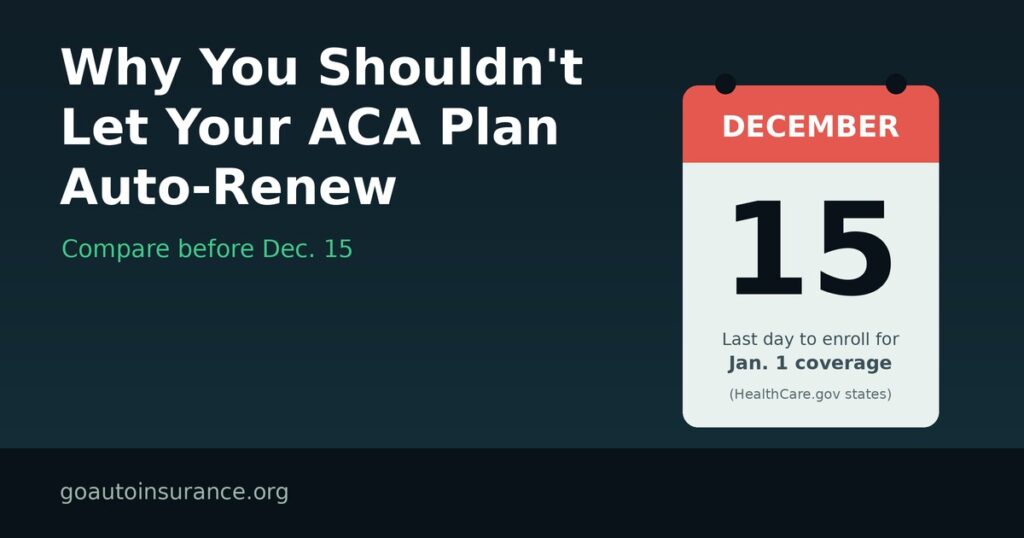
- Check the dates: on HealthCare.gov, pick a plan by December 15 for coverage starting January 1. Open enrollment continues through January 15, but coverage then starts February 1.
- You need to look at four numbers, not one: the monthly premium after your subsidy, the deductible, the out-of-pocket maximum, and whether your doctors and drugs are covered.
What auto-renewal does
When open enrollment arrives and you take no action, the marketplace automatically re-enrolls you. If your insurer still sells your plan, you are generally kept in that plan, or a similar one from the same company. If your insurer is leaving your area, the marketplace moves you to a plan from a different company.
A trade publication for insurance agents, summarizing federal marketplace guidance, describes the replacement as a plan from another insurer at the same metal level and product type, with the most similar provider network and, among those, the lowest premium. That sounds reasonable, but notice what it does not promise: that your doctors, your drugs or your deductible will match, or that the plan is the best deal for you.
A few other details matter:
- Your income may not be up to date. Auto re-enrollment uses your most recent application plus whatever updated income information the marketplace can obtain. If your income changed in 2026, update your application so your 2027 tax credit is right.
- Off-exchange plans are different. If you bought directly from an insurer, nobody re-enrolls you automatically if that insurer leaves. You have to choose a new plan yourself.
- State marketplaces differ. Some states automatically move members to a comparable plan, while others require you to choose. For example, reports say Connect for Health Colorado and Get Covered Illinois will not place Cigna members in a new plan, while Georgia Access may.
- The rules can change. Federal law and rules about enrollment are in flux, and a court blocked a rule that would have shortened open enrollment. Always check HealthCare.gov or your state marketplace for the current rules.
Why 2027 is a riskier year to coast
1. Premiums are rising again
KFF’s analysis of finalized rates found benchmark silver premiums will rise by an average of 13% next year, following double-digit increases the year before. KFF also found benchmark premiums have risen an average of 42% between 2025 and 2027. Your plan’s increase may be higher or lower than the average.
2. Your subsidy depends on the benchmark plan, not your plan
Tax credits are tied to the cost of the benchmark plan, which is the second-lowest-cost silver plan in your area. When the benchmark changes, your subsidy can change even if your own plan stays the same. That is why your net monthly bill can look very different from last year. Those with incomes above four times the federal poverty level get no subsidy at all. For this open enrollment, that cutoff is $63,840 for a single person, according to NPR.
3. Insurers are leaving
KFF counted 11 insurers announcing exits from the marketplaces for 2027 as of late October. The biggest is Cigna, which announced in April that it would stop selling individual plans in all 11 states where it operates, affecting about 369,000 members, according to reporting on the announcement. Its current plans stay active through December 31, 2026. If you are one of them, auto-renewal means a plan you did not choose, possibly with different doctors and a different deductible.
4. People who auto-renewed last year often paid more
KFF’s Cynthia Cox said that a large part of 2026’s enrollment decline came from people being auto-renewed into plans that became far more expensive after the expiration of enhanced subsidies. KFF’s follow-up survey found about one in 10 enrollees had dropped their marketplace coverage and about three in 10 had switched plans. Among those who stayed covered, the average deductible rose by more than $1,000, and the average monthly premium payment rose by $65.
5. The out-of-pocket limit is going up
The legal ceiling on what a marketplace plan can make you pay for covered in-network care rises to $12,000 for one person in 2027, from $10,600 in 2026, and $24,000 for a family. Plans can set lower limits, which is one more reason to compare.
A simple example of why the premium isn’t the whole story
This is a hypothetical illustration, not data from real plans.
Suppose you are comparing two plans for one person:
- Plan A: $400 a month ($4,800 a year), with a $12,000 out-of-pocket maximum.
- Plan B: $520 a month ($6,240 a year), with a $6,000 out-of-pocket maximum.
If you stay healthy and barely use care, Plan A is cheaper by about $1,440. But if you have a bad year, the most you could pay is about $16,800 on Plan A ($4,800 plus $12,000) versus about $12,240 on Plan B ($6,240 plus $6,000). That is a worst-case difference of $4,560 in favor of Plan B.
Neither plan is automatically better. The right one depends on how much care you expect to use, and auto-renewal skips that question entirely.
[Optional but recommended: add a short paragraph from your own experience, such as how you or someone you know handled open enrollment, in your own words. Only include things that are true.]
Four questions to decide if auto-renewal is risky for you
- Is your insurer leaving, or did you get a notice saying your plan is changing? If yes, you need to choose actively.
- Did your income, household or job change this year? If yes, update your application so your subsidy is right.
- Do you take regular medications or see specific doctors or specialists? Check that each plan still covers them.
- Is your 2027 price much higher than last year’s? If yes, comparing may find a cheaper option.
If you answered no to all four and you are satisfied with your plan, auto-renewal may be fine, but it is still worth a quick look.
A 10-minute check that can save real money
1. Open your mail and email
HealthCare.gov says a notice will arrive telling you whether you will be moved into the same plan or a different one, and your insurer will send its own explanation. These notices are easy to mistake for junk mail. Read them.
2. Log in and update your application
Go to HealthCare.gov or your state marketplace. Check your income estimate, household members, address and tax filing details.
3. Compare at least three plans
Look at more than the monthly premium. For each plan, write down:
- Premium after subsidy
- Deductible
- Out-of-pocket maximum
- Copays or coinsurance for the care you use most
4. Check doctors and drugs
Search for your doctors in each plan’s provider directory, and check your prescriptions on each plan’s drug list. Directories can be out of date, so call the doctor’s office to confirm they accept that specific plan.
5. Consider the metal level
Bronze plans usually have the lowest premiums and highest deductibles, and silver plans sit in the middle. Some lower-income households qualify for extra cost-sharing help, which is only available on silver plans and can lower deductibles and copays. If you may qualify, a silver plan could be a better value than it looks.
6. Look for state help
Some states offer their own subsidies on top of federal ones. Virginia and Rhode Island are among those adding new programs for 2027. Check your state marketplace.
7. Pick a plan by December 15 and confirm it
On HealthCare.gov, enrolling by December 15 means coverage starts January 1. Enrolling between December 16 and January 15 means coverage starts February 1, which can leave a one-month gap. Some state marketplaces have different deadlines. After you choose, check that you receive a confirmation and pay your first premium so your coverage becomes active.
8. Keep records
Save your confirmation, plan details and screenshots of the price you were quoted.
What if you miss the window?
You usually have to wait until the next open enrollment, with some exceptions:
- Special enrollment periods. A qualifying life event, such as losing other coverage, having a baby, or moving, generally gives you 60 days to pick a plan.
- Medicaid and CHIP. You can apply any time of year if you qualify.
Common mistakes to avoid
- Looking only at the monthly premium. The deductible and out-of-pocket maximum can matter as much.
- Assuming your doctors and drugs carry over. Networks and drug lists change.
- Forgetting to update income. Wrong income can mean the wrong subsidy, and a surprise at tax time.
- Waiting until the last day. Websites get busy, and brokers may be harder to reach. KFF Health News reported that a federal rule means brokers new to the federal marketplace cannot help with enrollments for 2027 until February.
- Ignoring your notice. It tells you what the marketplace plans to do for you.
Frequently asked questions
How do I know whether I was automatically re-enrolled?
Log in to your HealthCare.gov or state marketplace account and look at your 2027 application. Your notices will also say what plan you were assigned.
If I pick a new plan, does it cancel the automatic one
Generally, selecting a plan yourself replaces the automatic enrollment. Confirm in your account that only the plan you chose is listed, because reports from Florida suggest people can be enrolled in plans without realizing it.
Can I change plans after December 15?
On HealthCare.gov, open enrollment continues through January 15, but coverage starts February 1 if you enroll after December 15. State marketplaces may differ.
Do I need a broker?
Not necessarily. HealthCare.gov offers free help from trained assisters, and many states have navigators. Reach out early.
Is auto-renewal ever the right choice?
Sometimes. If your plan is the same, the price is fine, your doctors and drugs are covered and your information is up to date, it can be fine. Just confirm each of those things first.
Sources and further reading
- HealthCare.gov, dates and deadlines for 2027 health insurance (official source for current dates).
- SuperMoney, 2027 ACA open enrollment starts Nov. 1: don’t let your plan auto-renew: https://www.supermoney.com/aca-open-enrollment-2027-dont-auto-renew
- MoneyGeek, What is open enrollment and when is it?: https://www.moneygeek.com/insurance/health/what-is-open-enrollment/
- Cronista, Cigna dropping ACA plans in 11 states, what you need to do: https://www.cronista.com/en/health-science/policy-shift-cigna-dropping-aca-plans-in-11-states-affecting-more-than-360000-enrollees-what-you-need-to-do/
- ABC News via WPVI, With premiums on the rise, what to know as ACA open enrollment begins (KFF analysis): https://6abc.com/story/premiums-rise-what-know-aca-coverage-open-enrollment-begins/20009427/
- KFF Health News via NPR, It’s ACA open enrollment time. Here are the changes for health insurance shoppers: https://www.kbbi.org/npr-news/2026-11-01/its-aca-open-enrollment-time-here-are-the-changes-for-health-insurance-shoppers
- Daily Herald, Affordable Care Act enrollment projected to plunge by 5 million as costs spike (KFF analysis): https://www.dailyherald.com/20260519/health-care/affordable-care-act-enrollment-projected-to-plunge-by-5-million-as-costs-spike-analysis-shows/
- KFF event summary, Costs, coverage, and enrollment changes: Exploring current public opinion and policy on the ACA marketplaces: https://www.kff.org/event/costs-coverage-and-enrollment-changes-exploring-current-public-opinion-and-policy-on-the-aca-marketplaces/
- NBC San Diego, ACA enrollment projected to plunge by 5 million: https://www.nbcsandiego.com/news/national-international/affordable-care-act-enrollment-projected-to-plunge-5-million/4028086/
- Money Talks News, 11 insurers are leaving Obamacare markets for 2027: https://www.moneytalksnews.com/insurers-are-leaving-obamacare-markets-for-is-yours-one-of-them/
- Premier HS, Insurers leaving ACA in 2027: what agents should tell clients: https://premierhsllc.com/aca-insurer-exits-2027-what-agents-should-tell-clients/
- WPTV, Some Florida ACA customers are being auto-enrolled in new 2027 plans without their knowledge: https://www.wptv.com/news/state/navigating-aca-enrollment-tips-and-a-warning
- HealthInsurance.org, 2027 ACA open enrollment: what’s changing: https://www.healthinsurance.org/blog/2027-aca-open-enrollment-whats-changing/
- Your state marketplace and state Department of Insurance.
Dates, rules and premiums change, and sources do not always agree. A court blocked a federal rule that would have shortened open enrollment, and the government has appealed, so check HealthCare.gov or your state marketplace for the current deadline before you act. Several sources are insurance agents, brokers or commercial sites, and figures are averages that may not match your plan.
This article is general information, not insurance, legal or financial advice. Policies, prices and rules vary by insurer and location, so confirm details with your insurer or a licensed agent. See our editorial policy.