Discover Why Home Insurance Is Still Rising, But More Slowly
If you notice your homeowners insurance renewal still came with a higher bill this year, you may be surprised why you keep hearing that the market is “improving”. Both things are true. Rates are still increasing in most places, but the increases are smaller than the double-digit jumps of recent years, and a growing number of homeowners are seeing flat or lower prices. This guide explains what changed, what has not, and what you can do at your next renewal.
Points to note
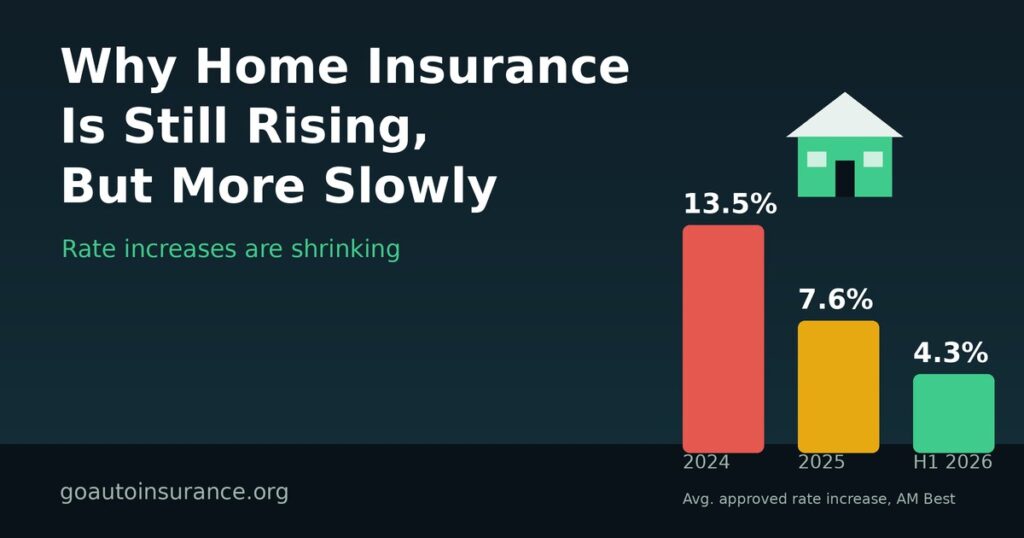
- Average approved rate increases have slowed sharply, from 13.5% in 2024 to 7.6% in 2025 and 4.3% in the first half of 2026, according to rating agency AM Best.
- A slower increase is not a lower price. Premiums are still rising on top of years of large hikes.
- The main reasons for the slowdown are a calmer 2025 hurricane season, lower reinsurance prices and insurers’ earlier rate increases and tighter underwriting.
- The main reasons rates are still rising are record claim costs, higher rebuilding costs and expensive severe storms.
- Where you live matters a great deal. Some states are flattening while others are still climbing.
What the numbers show
AM Best reported that the average approved homeowners rate increase fell from 13.5% in 2024 to 7.6% in 2025, and to 4.3% in the first half of 2026. Insurify, an insurance marketplace, forecasts that rates will rise about another 4% by the end of 2026, bringing the national average to about $3,057 a year.
To see what that means, here is an illustration (not a prediction for your policy). On a $3,000 policy, a 4% increase adds about $120 a year. A 13.5% increase, like the average in 2024, would have added about $405.
Other data points tell the same story:
- New policies: Matic, an online insurance brokerage, reported that premiums for newly written policies rose 5.9% in the first half of 2026 compared with the year before. The pace has been slowing since it peaked in 2024.
- Some relief, but not for most: Matic also found 11.7% of homeowners saw their premium decrease in the first half of 2026. That means roughly 88% paid the same or more.
- A survey view: In an Insurance.com survey, 32% of homeowners said they had no rate increase in the past year in 2026.
- The U.S. in context: According to the OECD’s Global Insurance Market Trends 2026 report, U.S. home insurance premiums rose 8.2% in 2025, nearly four times the median 2.1% rise across 27 member countries.
These sources use different methods. Some measure approved rate filings, some track new policies, and some survey homeowners, so the numbers will not match exactly. The direction is the same: still rising, but slower.
Why the increases are slowing
1. Insurers are making money again
After years of losses, U.S. homeowners insurers posted a $16.5 billion underwriting profit in 2025, according to AM Best. That reversed a net underwriting loss of about $1.3 billion in 2024 and was the line’s first underwriting gain since 2019. When insurers are profitable, they have less pressure to push for large increases.
AM Best credited several things: sustained rate increases in earlier years, more precise underwriting, better catastrophe modeling and improved claims handling.
2. A calmer 2025 hurricane season
The 2025 hurricane season was the first in about a decade without a major U.S. landfall, which kept hurricane losses low. Lower catastrophe losses helped insurers’ results and took pressure off prices.
3. Cheaper reinsurance
Reinsurance is insurance that insurers buy for themselves to cover very large losses. When reinsurance gets expensive, primary insurers pass the cost on to homeowners. In 2026, reinsurance prices have been easing. AM Best said falling reinsurance prices are helping drive the turnaround, giving carriers room to slow rate increases and offer more coverage.
4. Tighter underwriting and more competition
After earlier increases, insurers have also changed which risks they accept and how they price them, using tools such as aerial imagery and predictive models. Insurance Business reports that carriers are writing new business in California again, and Matic describes competition returning to the market. More competition can mean more options for shoppers.
Why rates are still going up
The market is stabilizing, but several costs remain high.
Costlier claims
The average cost of a home insurance claim, which insurers call claim severity, hit a record high in 2025, rising almost 26% from 2024, according to the LexisNexis U.S. Home Trends Report published in July 2026. When the average claim costs more, rates tend to follow, even for homeowners who never file one.
Rebuilding costs
The more it costs to rebuild a home, the higher claim costs become. Higher prices for materials and construction labor remain a main driver of rate increases, according to Openly, an insurer.
Severe storms
Severe convective storms, meaning hail, tornadoes and damaging straight-line winds, caused about $51 billion in U.S. insured losses in 2025, the third year in a row above $50 billion, according to Triple-I. Analysts say these storms are now a nationwide concern, not just a problem for the central U.S., and they are harder to insure against than hurricanes because they happen throughout the year.
Where you live
Regional differences are large. Insurance.com’s data showed Louisiana had the biggest two-year increase, 58% from 2023 to 2025, while Florida, still the most expensive state, saw a slight decrease over the same period. Midwestern and Great Plains states have seen sharp increases from severe storms. Insurance rates are regulated by each state, so your local picture can look quite different from the national average.
What this means for you
- Expect smaller increases, not price cuts. For most homeowners, 2027 looks more likely to bring a modest rise than a drop, though no one can promise it.
- Your own situation matters. Your location, roof, claims history and insurer all affect your price.
- Mortgage payments can change. If your insurance is paid through a mortgage escrow account, a higher premium raises your monthly payment.
[Optional but recommended: add a short paragraph from your own experience, such as how your own or a friend’s renewal changed this year, in your own words. Only include things that are true.]
What you can do at your next renewal
1. Read the renewal notice line by line
Compare the new notice with last year’s. Check the dwelling limit, personal property limit, liability limit, deductibles and any new exclusions or endorsements. Sometimes the price changed because the coverage did.
2. Check that your home’s details are correct
Insurers use data such as roof age, square footage, construction type and distance to a fire station. Errors can raise your price. If something is wrong, give your insurer documentation, such as a roof replacement invoice or an inspection report, and ask them to update it.
3. Shop around
With more competition returning, comparing quotes is worth the time. Get at least three quotes with the same coverage limits and deductibles, including smaller or regional insurers and an independent agent. Make sure you compare like for like, because a cheaper quote may carry a higher deductible or weaker roof coverage.
4. Make sure your coverage matches rebuilding costs
Your dwelling coverage should reflect what it would cost to rebuild, not the market value or the purchase price. Ask your insurer how they calculated it. Being underinsured can cost much more than a slightly higher premium.
5. Understand replacement cost vs actual cash value
Some policies pay actual cash value, which accounts for depreciation, on older roofs. That can leave you paying a large share of a roof claim yourself. Ask how your roof is covered.
6. Consider a higher deductible, carefully
A higher deductible lowers your premium, but you pay more when you claim. Only choose an amount you could comfortably pay in cash. Also check whether your policy has a separate wind or hail deductible, which is often a percentage of your home’s value.
7. Ask about discounts and home-hardening
Ask about discounts for bundling home and auto, claims-free history, security systems, newer roofs and wiring. Insurify notes that in storm-prone areas, home-hardening improvements, such as stronger roofs or shutters, could earn a discount with some insurers. Ask before you spend money so you know what your insurer would credit.
8. Think carefully before filing small claims
Before filing a claim, weigh the repair cost against your deductible and understand how a claim might affect your future premiums, as Insurify advises. Policies and state rules differ, so ask your insurer before you decide.
9. Don’t let your coverage lapse
If you have a mortgage, your lender requires continuous coverage. If your insurer drops you, compare other insurers and ask your state insurance department about options, including your state’s insurer of last resort.
10. Check what’s not covered
Standard home insurance generally excludes flooding and earthquakes, which need separate policies. Ask whether those risks apply where you live.
Common mistakes to avoid
- Choosing on price alone. The cheapest quote may cover less.
- Assuming a slower increase means a cheaper policy. Rates are still rising from an already high level.
- Ignoring your dwelling limit. Rebuilding costs rise, so review it every year.
- Skipping the renewal notice. Changes to coverage can hide inside it.
- Waiting until you are dropped. Start shopping early if you live in a high-risk area.
What to watch next
Prices in 2027 will depend on whether storms stay costly, whether reinsurance stays cheaper, and whether construction costs keep climbing. Reinsurance prices and weather can change quickly, so treat any forecast as an estimate, not a promise.
Frequently asked questions
Will home insurance rates go down in 2027? For most homeowners, they are more likely to keep rising at a slower pace than to fall, though some states and insurers may see decreases. No one can guarantee this.
Why did my premium go up if I have never filed a claim? Insurers set prices based on the cost of claims across your area and portfolio, not just your own history. Rising claim and rebuilding costs raise rates for everyone nearby.
Is it worth switching insurers just to save money? Often yes, if the coverage is truly the same. Look at claims service and financial strength too, not only price.
Does a new roof lower my premium? It can, because roof age and condition matter to many insurers. The size of the effect varies, so ask your insurer before paying for a replacement.
Sources and further reading
- Insurance Business, Home insurance premiums climb at nearly four times global pace (OECD data): https://www.insurancebusinessmag.com/us/news/property/home-insurance-premiums-climb-at-nearly-four-times-global-pace-597465.aspx
- Insurance Business, Homeowners rate increases slow to 4.3% as insurers bank first underwriting profit in six years: https://www.insurancebusinessmag.com/us/news/property/homeowners-rate-increases-slow-to-4-3-as-insurers-bank-first-underwriting-profit-in-six-years-591523.aspx
- Carrier Management, on AM Best’s homeowners report: https://www.carriermanagement.com/news/2026/10/02/292424.htm
- Reinsurance News, Falling reinsurance prices support major turnaround in US homeowners market: https://www.reinsurancene.ws/falling-reinsurance-prices-support-major-turnaround-in-us-homeowners-market-am-best/
- Insurify, Costlier claims push home insurance costs up for all, even those who never filed: https://insurify.com/homeowners-insurance/news/why-rates-rise-without-a-claim
- Matic, 2026 Home Insurance Report: https://matic.com/blog/2026-home-insurance-report/
- Mortgage Research Center, Homeowners insurance premiums rising more slowly: https://www.mortgageresearch.com/articles/homeowners-insurance-premiums-rising-more-slowly/
- Openly, 2026 Home Insurance Trends: A Mid-Year Reality Check: https://openly.com/the-open-door/articles/the-open-door/articles/2026-home-insurance-trends-mid-year
- Insurance.com, Home insurance premium trends: https://www.insurance.com/home-and-renters-insurance/home-insurance-premium-trends/
- Insurance Business, Severe storm losses stay above $50 billion for third year (Triple-I): https://www.insurancebusinessmag.com/us/news/catastrophe/severe-storm-losses-stay-above-50-billion-for-third-year-571849.aspx
- GPB/NPR, 2025 saw relatively fewer natural disasters. Will you get a break on home insurance?: https://www.gpb.org/news/2026/03/11/2025-saw-relatively-fewer-natural-disasters-will-you-get-break-on-home-insurance
- Your state’s Department of Insurance, and your own insurer’s policy documents.
Figures come from rating agencies, trade publications, insurers and brokerages, use different methods, and are averages that may not match your situation. Several sources are companies that sell insurance, so check key numbers against a regulator or rating agency where possible.
This article is general information, not insurance, legal or financial advice. Policies, prices and rules vary by insurer and location, so confirm details with your insurer or a licensed agent. See our editorial policy.