Why Insurers Are Dropping Homeowners and What you need to Do
Emails from your home insurer are more worrisome than a letter from them saying it will not renew your policy. Your coverage is ending, your mortgage lender will want proof of insurance, and you may have only weeks to find a replacement. If this has happened to you, or you are worried it might, this guide explains what a nonrenewal is, why more insurers are doing it, and exactly what to do next.
Points to note
- A nonrenewal means your insurer has decided not to offer you another policy term. It is different from a cancellation in the middle of a term.
- Insurer-initiated nonrenewals have risen sharply across the U.S., according to the first national report of its kind from state insurance regulators.
- Reasons range from your own home (an old roof, a claims history) to the insurer’s decisions about where it wants to do business.
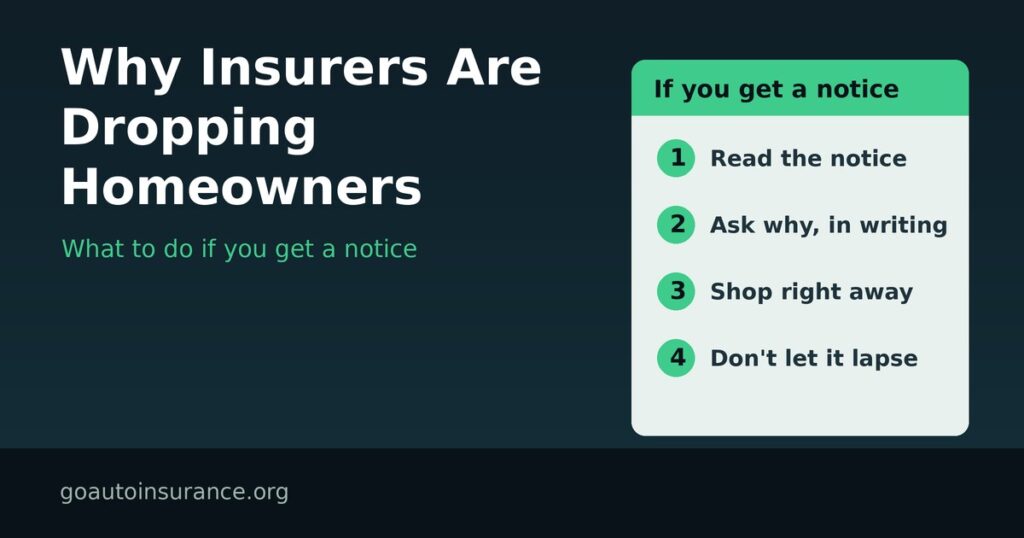
- You usually have time to act. The most important steps are to read the notice, ask why, shop immediately, and never let your coverage lapse.
- If private insurers will not cover you, state programs called FAIR Plans exist as a last resort, though they have limits.
Nonrenewal vs cancellation: what is the difference?
The two words sound alike, but they are different events.
- Nonrenewal: your insurer chooses not to offer you a new policy when the current term ends. Your coverage continues until the end date on the notice. Most states require the insurer to warn you in writing in advance, and many require them to state a reason, but the details vary by state.
- Cancellation: your insurer ends the policy before the term is up. In general, this is allowed only for narrow reasons, such as not paying your premium or fraud, though rules differ by state.
This guide focuses on nonrenewal, but several of the steps also apply if your policy is canceled.
How common are nonrenewals?
The National Association of Insurance Commissioners (NAIC), the organization of state insurance regulators, published its first national look at homeowners insurance market data on July 31, 2026, and released it publicly in early August. It covers 2018 through 2024 and draws on data collected from insurers by state regulators.
What it found:
- About 715 companies wrote homeowners coverage in 2024, covering roughly 103 million policies.
- Insurer-initiated nonrenewal rates rose in every region of the country, by between 96% and 216% from 2018 to 2024, depending on the region. The West saw the largest increase, 216%. The Northeast saw 147%, and the Southeast 96%.
- In 2024, company-initiated nonrenewal rates ranged from 11.7 to 25.1 per 1,000 policies, which works out to roughly 1% to 2.5% of policies in the regions studied.
- Inflation-adjusted average premiums rose between 18.3% and 43.3% across the regions over the same period.
- Large insurers operating in many states were often among those cutting policy counts, while smaller regional and state-focused insurers took on much of that business, according to the NAIC.
It helps to keep the scale in view. For most homeowners in most places, a nonrenewal is still unlikely in any given year. But the averages hide big local differences. The NAIC itself cautioned that regional figures can mask serious problems in individual states and communities.
Later data points to the same pattern. Based on 2025 data reported to the NAIC, Utah had the country’s highest homeowners nonrenewal rate, and public radio reports said several Western states were above 1%, with Arizona just over 2%. Earlier federal Treasury analysis of 2018 to 2022 data found nonrenewal rates in the riskiest 20% of ZIP codes were about 80% higher than in the least risky 20%.
Why insurers drop homeowners
The NAIC does not point to one cause. It describes homeowners insurance as a local market shaped by weather risk, rebuilding costs, claims patterns and insurer participation. Commentary on the report lists three forces working together: higher rebuilding costs, more frequent and severe weather-related claims, and insurers narrowing where and what they are willing to insure.
For an individual homeowner, a nonrenewal usually comes down to one or more of these.
1. Where your home is
Insurers track how many policies they hold in each area, because too many in a wildfire, hurricane, hail or flood zone can mean a disaster hits many customers at once. Sometimes an insurer reduces exposure in an entire area, or even a whole state. In that case it has nothing to do with you personally.
2. Your roof and the condition of your home
Roof age and condition matter a great deal. In February 2026, the Connecticut Insurance Department warned consumers that insurers are assessing roof condition using satellite and drone images. In California, the FAIR Plan has tightened its roof rules, and will not offer full replacement-cost coverage on homes over 25 years old unless the roof has been replaced within a set time. Other hazards an inspection or photo might flag include missing shingles, tarps, overgrown trees, standing water, and damaged or unsafe structures.
3. Your claims history
Filing several claims in a short period, or a large claim, can lead an insurer to decide the policy is no longer profitable. Kiplinger lists having filed too many claims among common reasons.
4. New technology and data
United Policyholders, a consumer advocacy group, points to insurers’ use of aerial imagery, artificial intelligence and predictive models, along with higher construction costs and severe weather, as reasons behind more nonrenewals. This means a problem you have never noticed can show up in an insurer’s data. It also means errors can show up.
5. Business decisions
Insurers sometimes stop writing certain home types, such as older homes or homes with certain features, or leave a market after heavy losses. When a company exits, everyone on that book can be non-renewed at once.
[Optional but recommended: add a short paragraph from your own experience, such as how you or someone you know handled a nonrenewal, in your own words. Only include things that are true.]
What to do if you get a nonrenewal notice
Here is a practical order of steps. Your policy normally stays in force until the end date on the notice, so you have time, but not a lot of it.
Step 1: Read the notice carefully
Find the effective date, the reason given, and any information on your rights or how to appeal. Note whether it is a nonrenewal or a cancellation. Keep the envelope and the date you received it.
Step 2: Check the notice period
Many states require advance written notice. Texas, for example, requires at least 60 days before the policy expires, according to United Policyholders. Other states differ, so look up your state’s rule on your Department of Insurance website. If your notice came with less time than your state requires, ask the department about it.
Step 3: Call your insurer and ask why
Ask for the specific reason in writing. Ask whether the decision can be reversed or reviewed, and what you would need to do to be eligible for renewal, for example repair work, a roof inspection or a corrected record. Experian advises asking how you can get your coverage reinstated before moving on. Ask for copies of any inspection report or photos they relied on.
Step 4: Correct mistakes and fix what you can
If the reason is wrong, such as an incorrect roof age or a claim that is not yours, send documents showing that. If the reason is a repair, such as a damaged roof, fix it and send proof. Keep copies of everything, and make a note of calls: date, name and what was said.
Step 5: Start shopping right away
Do not wait for the insurer’s answer. Contact an independent agent, who can quote several companies, and ask about smaller or regional insurers, which the NAIC says have been absorbing much of the business large insurers are shedding. You can also use an online marketplace. Answer application questions honestly, including whether you have been non-renewed, because leaving it out can cause bigger problems later. Get more than one quote, and compare coverage, not just price.
Step 6: Know the last-resort options
If regular insurers decline you, there are two main backstops.
- FAIR Plans. Most states, and the District of Columbia, run a Fair Access to Insurance Requirements (FAIR) Plan or a similar program, as the Consumer Financial Protection Bureau (CFPB) notes. These policies are meant for people who cannot get coverage elsewhere. Kiplinger points out that premiums may be higher for only basic coverage. The Insurance Information Institute keeps a list of FAIR Plan contacts by state. Some homeowners pair a FAIR Plan policy with a separate policy that fills the gaps, often called a difference in conditions (DIC) policy. Ask an agent whether you need one.
- Surplus lines insurers. If you cannot get a FAIR Plan policy, you may have to turn to surplus lines insurance, which can be even more expensive, according to The Motley Fool.
Step 7: Tell your mortgage lender, and never let coverage lapse
If you have a mortgage, your lender requires insurance. If your coverage lapses, the lender can buy a policy for you, called force-placed or lender-placed insurance. The CFPB says this usually protects only the lender, not you, and can cost about twice what you would normally pay. Under federal rules, your servicer must notify you at least 45 days before charging you for it. Once you have your own policy, you have the right to have the force-placed policy removed, so send your servicer proof of coverage quickly. Insurance company Kin notes that many force-placed policies do not cover your belongings or your personal liability.
Step 8: Contact your state insurance department
If you believe the nonrenewal was improper, or you cannot find coverage, contact your state’s Department of Insurance. You can also complain to the insurer’s consumer affairs division, as Insurify suggests. Regulators can explain your rights and sometimes point you to insurers that are accepting new business. If a force-placed policy is the problem, you can submit a complaint to the CFPB.
Step 9: Make your home easier to insure
While you look, think about improvements that insurers care about: a newer or well-maintained roof, trimmed trees, cleared debris, working smoke detectors and electrical safety. Ask an agent which ones would make a difference for your area before you spend money.
Step 10: If you own your home outright, don’t go without
Homeowners without mortgages can choose not to buy insurance, and officials say that is becoming more common after nonrenewals. But one fire or storm could cost you your home and savings. If premiums are the obstacle, compare options, raise your deductible, and ask about discounts before you consider going uninsured.
A simple timeline
- Day you get the notice: read it, note the end date, and call your insurer.
- First week: ask for the reason in writing, start getting quotes, and gather documents on your roof and home.
- Weeks 2 to 4: compare quotes, apply to a FAIR Plan if needed, and appeal if you have grounds.
- At least 2 weeks before the end date: choose a new policy, confirm the start date lines up with the old one, and send proof to your mortgage servicer.
- After: keep copies of everything, and review the new policy carefully, including exclusions.
Common mistakes to avoid
- Ignoring the notice. Time is limited.
- Waiting until the last week. Good options may disappear.
- Letting coverage lapse, even briefly. This can trigger force-placed insurance, and it can make it harder to get coverage.
- Assuming a FAIR Plan covers everything. Check what it excludes.
- Leaving out the nonrenewal on applications. Be honest.
- Choosing on price alone. The cheapest policy may leave big gaps.
Frequently asked questions
Can my insurer drop me for filing a claim? It can be a factor in a nonrenewal in many places, though rules vary by state. Ask your insurer and check with your state insurance department.
How much notice must I get? That depends on your state. Texas requires at least 60 days, but other states differ. Check your Department of Insurance website.
Will a nonrenewal follow me to my next insurer? Possibly. Insurers can see claims history, and applications ask about prior nonrenewals. It does not necessarily stop you from getting coverage, but it can affect which insurers and prices are available.
Will my new insurance cost more? Often yes, especially through a FAIR Plan or surplus lines insurer, but not always. Compare quotes carefully.
Can I challenge a nonrenewal? You can ask the insurer to reconsider and contact your state insurance department if you believe it was improper. Whether you can overturn it depends on the reason and your state’s rules.
Sources and further reading
- NAIC, Examining Homeowner Property Insurance Market Dynamics (July 31, 2026): https://content.naic.org/sites/default/files/mcas-homeowners-property-insurance-market-dynamics-report.pdf
- InsuranceNewsNet (Insurify), Home insurers dropped 2 million policies as premiums and profits rose: https://insurancenewsnet.com/oarticle/home-insurers-dropped-2-million-policies-as-premiums-and-profits-rose-insurify
- Beinsure, US homeowners face rising non-renewal risk: https://beinsure.com/news/us-homeowners-face-rising-non-renewal-risk/
- The Close, NAIC data: home insurance nonrenewals and premiums rising: https://theclose.com/news-homeowners-insurance-crisis/
- KUER, Utah saw the country’s highest home insurance nonrenewal rate in 2025: https://www.kuer.org/business-economy/2026-09-17/utah-2025-highest-home-insurance-nonrenewal-rate
- Weiss Ratings, Utah homeowners dropped by insurers at highest rate in nation: https://weissratings.com/en/weiss-news/utah-homeowners-dropped-by-insurers-at-highest-rate-in-nation
- Connecticut Insurance Department, consumer advisory (Feb 6, 2026): https://portal.ct.gov/cid/consumer-information-center/consumer-alerts/2026-consumer-alerts/advisory-2026-02-06
- Insurance Business, California insurers tighten roof coverage rules: https://insurancebusinessmag.com/us/news/property/california-insurers-tighten-roof-coverage-rules-576538.aspx
- United Policyholders, Dropped by your home insurer? Information for Texas residents: https://uphelp.org/buying-tips/dropped-by-your-home-insurer-information-for-texas-residents/
- CFPB, Consumer advisory: Take action when home insurance is cancelled or costs surge: https://www.consumerfinance.gov/newsroom/consumer-advisory-take-action-when-home-insurance-is-cancelled-or-costs-surge/
- Kiplinger, Four things you can do if your home insurance is canceled or not renewed: https://kiplinger.com/personal-finance/home-insurance/four-things-you-can-do-if-your-home-insurance-is-canceled-or-not-renewed
- The Motley Fool, Dropped by your home insurer? Steps to take now: https://www.fool.com/money/insurance/homeowners/articles/dropped-by-your-home-insurer-you-need-to-take-these-steps-now
- Experian, What to do if you’re dropped by your home insurance: https://www.experian.com/blogs/ask-experian/what-to-do-if-youre-dropped-by-your-home-insurance/
- Insurify, How to get insurance after non-renewal: https://nextjs.insurify.com/homeowners-insurance/how-to-get-insurance-after-non-renewal
- Kin Insurance, Homeowners insurance non-renewal: https://www.kin.com/blog/homeowners-insurance-non-renewal/
- Your state’s Department of Insurance, and the Insurance Information Institute’s list of FAIR Plans.
Figures come from regulators, trade publications, advocacy groups and companies that sell insurance. They are averages and may not reflect your state or situation, and state rules differ and change. Check your own state’s rules before relying on anything above.
This article is general information, not insurance, legal or financial advice. Policies, prices and rules vary by insurer and location, so confirm details with your insurer or a licensed agent. See our editorial policy.